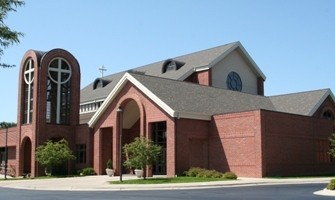
In 1963, a new Catholic parish was born on land that had been a field of sunflowers and in what was then the northwestern edge of Omaha.  It was named St. James to honor the memory of three former bishops of Omaha: James O'Gorman, James O'Connor and James Ryan.   Soon, a school and a temporary church were built, and as the parish grew and thrived, additions and renovations followed.   But it wasn't until nearly 40 years later - that the "temporary" church was able to give way to a permanent building.

The December 1, 2002, dedication of a new St. James church was a defining, historic  and thrilling - moment for the parish.   Consider it a celebration of the fruits of that 40-year wait: A church design that showers honor and glory on our Lord.   A wondrous space that offers a reverent environment for praise and worship.  A church that provides room for a greater experience of community before, during and after Mass.

For some, this "tour" is meant to serve simply as an introduction to our facility.   For others, it is intended to put a heart and a soul on a project that, to those passing by it, has seemed to be mostly bricks and mortar.   But mostly, this is a thank you to the many parishioners and others who have done so much and waited so long to turn a dream into a wonderful reality.

The Parish Center was added to the existing school building in the 1980s. Additional classrooms were also added on the second floor. The glass enclosed vestibule (entry) initially looked out into the parking lot. Following the construction of the Church in 2002, the vestibule became the entry from the church into the Parish Center. 

2024 renovations of the St. James Parish Center provide a new look for the parish center. Added space boosts the tabled seating capacity to 380, more than adequate for almost all functions: meetings, education sessions, receptions. 


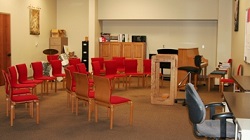
Our Parish Center has a large main room that can be divided by moveable walls into several smaller spaces. Round tables seating eight are available as are a variety of rectangular tables.


At the far end of the Parish Center is a dance floor and an exit to the patio.   The kitchen can be opened to serve food easily. The kitchen is equipped with refrigerators, convection ovens, dish washers, an ice maker and a variety of dishware. All food is to be catered. There is a rear entrance for caterers.


 Click here for the full tour


Our parish center is available for rental and provides a welcoming space for
family gatherings, receptions, meetings, and other special occasions.

If you would like to reserve rooms in the parish center
or receive more information about availability, rental fees, and amenities,
w
e would be happy to assist you in planning your event.

Contact Deacon Duane Karmazin 
dkarmazin@stjamescatholicchurch.org
402-572-0499


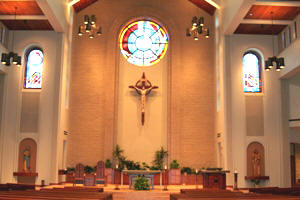
The sanctuary is the area of the church where the main ritual actions of the liturgy take place and where the Word of God is proclaimed.

The Altar

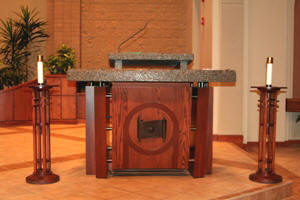
Today's altar is a return to that of the early Church, both in its facing the congregation and in being a table around which the clergy and congregation can gather.  It is the table of the Lord and a place where the Sacrifice of the Cross and banquet of the Lord are made present under sacramental signs.  The one table is seen as a symbol of the one Christ for one community.

The Church Building

Churches are never "simply gathering spaces but signify and make visible the Church living in a [particular] place, the dwelling of God" among us, now "reconciled and united in Christ."15  As such, the building itself becomes "a sign of the pilgrim Church on earth and reflects the Church dwelling in heaven."16  Every church building is a gathering place for the assembly, a resting place, a place of encounter with God, as well as a point of departure on the Church's unfinished journey United States Conference of Catholic Bishops, Inc., Washington, D.C. 2000 toward the reign of God. (Paragraph 17, Built of Living Stones, . [15, CCC, no. 1180; 16, RDCA, ch. 1, no. 2 {DOL, 547, no. 4370}; Cf. Canon Law Society of America, Code of Canon Law {CIC} (1998), c. 1214)

The altar and all other liturgical furnishings were designed by Steven Ginn, an architect at Zenon Beringer Mabrey Partners, Inc., the Omaha firm that designed the new church.   (Leading the ZBM team was company president Dave Beringer, St. James parishioner.)   ZBM's goal was that each piece be unique to St. James, the designs incorporating the legacy and lore of the parish and its patron saint.
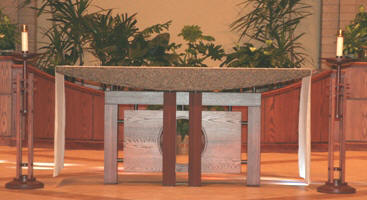
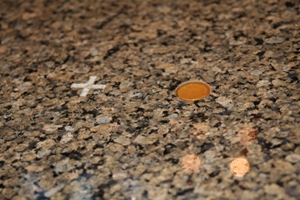
A 2,000 pound stone slab, the granite top, is the altar's predominant feature.   The altar, in the shape of a boat, includes a relic from an early church martyr.   Engraved on the top face are five crosses, which signify the five wounds of Christ.  

The altar is the natural focal point of the sanctuary...[and] since the Church teaches that "the altar is Christ,"73 its composition should reflect the nobility, beauty, strength, and simplicity of the One it represents.  (Paragraph 57, 56, Built of Living Stones.  (73, Ibid., no. 299)

Because the altar represents Christ, the Living Stone (1 Peter 2:4), the massive granite top is made of natural stone.   The granite originated in Saudi Arabia (the color, tropical brown, can be found only in that part of the world) and was carved and fabricated in St. Louis by Architectural Stone.   While the edges are rough, demonstrating that it is truly stone, the top surface is smooth and polished.

The boat shape reflects the belief and tradition that the body of St. James was miraculously transported in a stone boat from Jerusalem, where he was martyred, to northern Spain in A.D. 44.

In the Church's history and tradition, the altar was often placed over the tombs of the saints or the relics of saints were deposited beneath the altar.   The presence of relics of saints in the altar provides a witness to the Church's belief that the Eucharist celebrated on the altar is the source of the grace that won sanctity for the saints.79  Paragraph 60, Built of Living Stones. (70, Congregation for Divine Worship and the Discipline of the Sacraments, General Introduction to the Lectionary for Mass {GILM} (1998), no. 32)

The relic of the early church martyr is in a round, brass container embedded in the altar's granite top and is visible through a clear epoxy covering.   The relic had been in the altar in the former worship space.
The circle in the altar's design also has a tie to the apostle James - it was inspired by the facade of the cathedral at Santiago de Compostela in Spain, which sits over the tomb of St. James.   The circle also ties in to the structural design of the large, round stained glass window above the altar.  

Wood Specialties of Omaha, whose employees include St.

James parishioner Paul Kemp, built the altar's base of mahogany and red oak.   Paul and Wood Specialties also built many of the other liturgical furnishings, including the ambo and presider's chair.

The Ambo

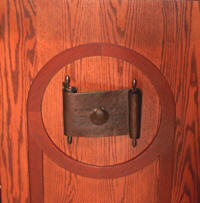
This is the liturgical furnishing from where the Scriptures are read and homilies are delivered.   The ambo's design is similar to the altar's, with a granite top and a wood base.   On the front of the ambo, the wrought iron scroll signifies that this is the place from which our ancient faith is proclaimed.

The Presider's Chairs

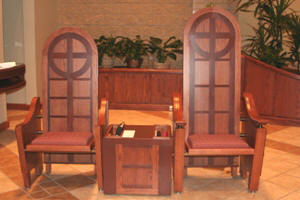
The chair of the priest celebrant reflects the dignity of the one who leads the community in the person of Christ.   This chair also is made of mahogany and red oak.   It and the accompanying deacon's chair - as well as the ambo carry the circle design from the stained glass window above the altar.   On the presider's chair and the deacon's chair there is a cross in the middle, similar to those in the bell tower.   That same cross design is found on the ends of the pews and elsewhere.

The cross on the presider's chair matches the bell tower crosses.

Built of Living Stones: Art, Architecture and Worship is a document issued by the United States Conference of Catholic Bishops on November 16, 2000, to assist those involved in the building or renovation of churches.   That includes parishes and their priests as well as architects, liturgical consultants and artists, contractors and other professionals involved in the design and/or construction of places of worship.   The document also offers explanations of the Catholic tradition regarding church buildings, the arts and architecture.   Built of Living Stones was used extensively the the architectural firm that designed the church, Zenon Beringer Mabrey, to guide its work.   Built of Living Stones © Copyright 2000.   All rights reserved.   Used with permission.
The Crucifix

The Cross

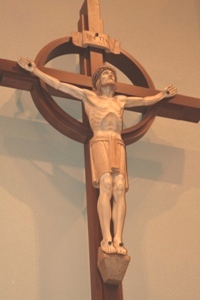
Made of mahogany and red oak, the elongated cross at St. James is 12 1/2 feet tall
and 7 1/2 feet wide and was built by Wood Specialties of Omaha.

The Corpus

The 6-foot corpus has a significant history. It hung on the chapel cross at Mount Michael Benedictine Abbey in Elkhorn before the chapel's renovation in 1995. Father Raphael Walsh, associate pastor at St. James, served as abbot at Mount Michael from 1964 to 1989. Knowing of the corpus' storage, the parish purchased it from the abbey  to be used in the new St. James church.

Wood Specialties refinished and refurbished the 45-year old corpus,  which is made of linden wood and was hand-carved in Italy.

The corpus of Christ came from the
chapel at the Mount Michael Abbey.

The cross with the image of Christ crucified is a reminder of Christ's paschal mystery. It draws us into the mystery of suffering and makes tangible our belief that our suffering when united with the passion and death of Christ leads to redemption.113  Paragraph 91, Built of Living Stones. (113. Cf. GIRM, no. 122)

Stained Glass

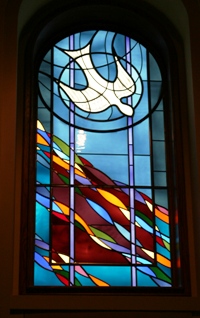
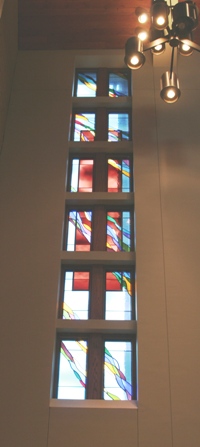
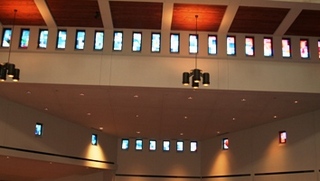
The use of stained glass in churches is a tradition that dates to the 12th century, and St. James has carried on that tradition, but with a contemporary feel.

Lambrecht Glass Studio in Omaha designed and created the new church's stained glass. It is a leaded stained glass, with the glass itself coming from Lamberts in Waldsassen, Germany. (Lamberts is one of the few remaining production sites for handcrafted, mouth-blown sheet glasses in the world.

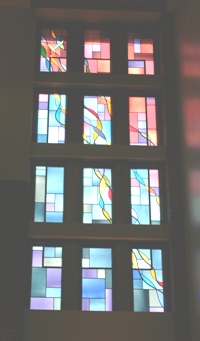
The theme of the design is flowing and contemporary but with the use of traditional symbolism throughout. Line designs are complemented by a royal and regal palette of colors - deep blues and purples in particular - that sets the mood emotionally within the worship space.

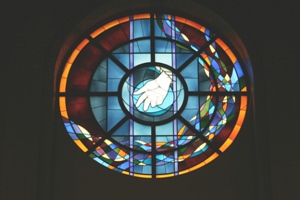
The hand of God the Father is at the center of
the stained glass window above and behind the altar.

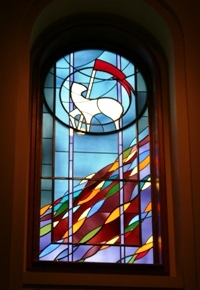
The premier works are the 12-foot round window above the altar and two arched windows, each nearly 9 feet high, on either side. The three windows together depict the Trinity. In the center is God the Father, symbolized by the hand of God coming down from above. It depicts a greeting or blessing and is meant to be calming, not forceful. Flanking that to the left (as you face the altar) is the Son, depicted as the sacrificial Lamb of God with the banner of victory, resurrection. Symbolized in the window to the right is the Holy Spirit, a descending dove. Within each of these windows is a meandering, curved line that symbolizes the word of God as it descends from heaven.

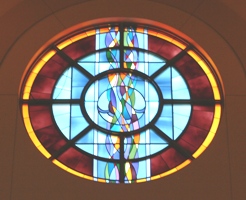
At the other end of the worship space and above the baptismal font is a 10-foot round window, which again has a flowing movement - symbolizing the power of the living waters of baptism. In the central area is a hint of a scallop shell, tying into the symbolism of the baptismal font itself.

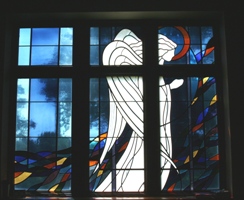
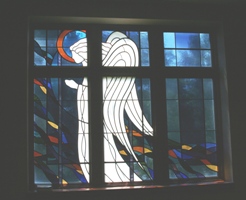
In the chapel area flanking the tabernacle are two 7-foot by 8-foot, three paneled windows featuring angels adoring the Eucharist. Especially here the design brings traditional and contemporary glass together. The windows are colorful, lined and flowing, giving them a contemporary feel, but with the angels symbolized in a traditional, recognizable form. Together the windows help make it a ponderous, contemplative space suitable for adoration.

Finally, there are vertical windows, each with 12 separate panes on both the east and west side flanks of the sanctuary. The movement from the altar continues through these windows, with colors that work with the brick in the structure to keep the altar area unified. Other windows in the worship space became stained glass when funds permitted.

West Sanctuary West Nave West Back of Nave

Liturgy and Worship

For every time the Church gathers for prayer, she is joined to Christ's priesthood and made one with all the saints and angels, transcending time and space. Together the members worship with the whole company of heaven, "venerating the memory of the saints" and hoping "for some part and fellowship with them"; together they eagerly await Christ's coming in glory. The sacred liturgy is a window to eternity and a glimpse of what God calls us to be. Paragraph 15, Build of Living Stones. (12. SC, no. 8)

Statues

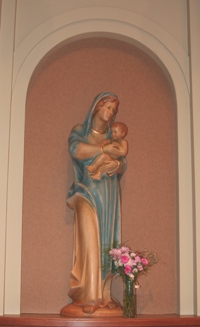
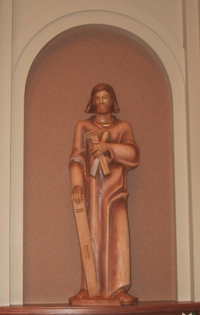
To the left as you face that altar is a 6-foot statue of the Madonna and Child. Created by Anton Fuetsch, an Austrian native who now lives and works in California, the statue is made of basswood and finished with a beeswax seal. Fuetsch also made the accompanying statue of Joseph displayed on the right side of the altar.

Niches

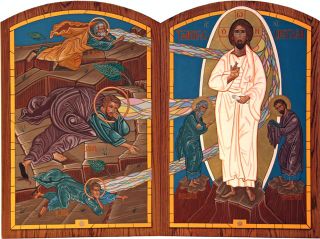
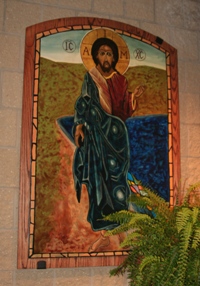
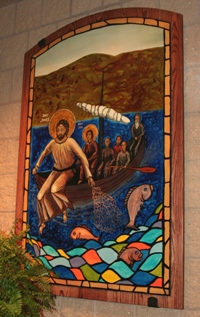
Icons of St. James are displayed in the two niches in the back of the nave. The icon of the transfiguration was prepared by our former pastor, Fr. Richard Reiser.

Icon of the Transfiguration (Mark 9: 2 - 10)
God our Father in the transfigured glory of Christ your Son,
You strengthen our faith by confirming the witness of Your prophets,
and show us the splendor of Your beloved sons and daughters.
As we listen to the voice of your Son, help us to become heirs to eternal life
with Him who lives and reigns with You and the Holy Spirit,
one God, forever and ever. Amen.  

Each icon panel measure 36" x 54"
Church of St. James, Omaha, Nebraska
Fr. Richard Reiser, iconographer

TRANSFIGURATION OF THE LORD

A HISTORY OF ICONS

An icon is a religious work of art done in a symbolic and stylistic manner.   Its main focus is not with realism but with spiritual realities.  The icon was a favorite art form that developed in the early Church and became the preferred style of religious representation for the Eastern Orthodox Church.   In the Roman Catholic Church, mosaics and types of statuary were the prominent styles of art used for religious representation.

Realism or accurate perspective is not a primary concern in iconography.  The main purpose of an icon is to draw the viewer into the realm of the holy through contemplation.   An icon in this sense means to "see through to the divine," or to be a "window to heaven".  In icons, the details of the eyes should draw the viewer into a vision beyond the present.   The perspectives are more subject-centered as a way of focus, rather than relying on realistic horizon lines.  The icon does not, after all, represent the material world, but the realm of the Divine.

The stoic faces on the figures in icons suggest that the holy ones, whose lives of service work are now accomplished on earth, now contemplate and rest in the presence of the Divine (signified by the light [halo] which surrounds the heads of the holy figures).

THE TRANSFIGURATION ICON

The two-panel icon of the Transfiguration has been done in a contemporary method and should be understood as a religious painting done in an iconographic style since it was not written (painted) following the strict rules of traditional icons that included rigorous fasting, special prayers, and special mixing of pigments with egg whites.   This icon is written with acrylic paints.

The two oaken panels each measure 36" x 54", and their rounded tops echo the architectural detail found elsewhere in the church.  The event of the Transfiguration is found in Matthew 17: 1 - 8 and Mark 9: 2 - 8.  The naming of the icon (Transfiguration) is done in English, but in a contemporary Slavonic (Old Russian) style of lettering.

The images on the panels are of Jesus Christ, St. Elijah1, St. Moses1 St. Peter, St. James, and St. John.   Jesus Christ and St. James are larger than the other figures to give them prominence;   Jesus, since he is the main figure of the Transfiguration, and St. James, since he is the patron of the parish.   The icon is designed to invite the viewer to participate in the event of the Transfiguration by allowing the light coming from Christ in the first panel to confront the viewer, then, inviting the viewer to connect the light of Christ to the apostles in the second panel.   The rays of light that emanate from Christ were done in a stained-glass style that reflects the shape and colors of the stained glass found elsewhere in the church2.

THE MOUNT TABOR PANEL (at right)

The central figure of the right panel is Jesus Christ, clothes in white and surrounded by light in the traditional manner which depicts Him in glory, along with the creedal statement of "Light from Light."  The aureole (the gold-leaf background) which surrounds the entire body of Jesus.   Christ's halo contains the traditional Greek letters that identify Jesus Christ as "I Am," the title of God given to Moses in Exodus 3:14 and given human expression in Jesus as the divine Son of God.   The Greek letters to the left and right of the aureole are the traditional abbreviations for "Jesus Christ."   High right hand is raised in the traditional gesture of blessing where the two joined fingers represent the two natures ( human and divine) of Christ.   A scroll is held in Christ's left hand and is symbolic of Christ being the Word that became flesh (John 1:14).

The haloed figure of Moses to the right of the Christ figure bows in deference towards Christ who is the completion and fulfillment of the law.   Moses reverently holds the two tablets of the Ten Commandments without directly touching them.  They symbolize the law with the word Torah3 inscribed on them in Hebrew.   Moses is represented as the younger man than he was at the time he received the tablets of the law.   The garments of Moses are brownish red and blue.
The haloed figure of Elijah to the left of the Christ figure, also defers to Christ as the completion and fulfillment of the prophets.   Elijah was taken up to heaven in a whirlwind.  His garments are green and blue.

All three figures on the right panel stand atop Mount Tabor4.  The mountain suggests the place of God's revelation to Moses in the Old Testament when he was given the law (Deuteronomy 5), and the place where Elijah the prophet experienced the voice of the Lord in the gentle breeze (1 Kings 19: 8 - 13).   Icons of the Transfiguration show Jesus Christ as God's full revelation by being presented on a mountain.

THE APOSTLES PANEL (at left)

The apostles panel of the left is divided into three plateaus each supporting one of the apostles closest to Christ.   The center plateau is larger and bright and it supports St. James.   He is shown humbled on his knees, because of the experience of the Transfiguration.   He is reaching forward while attempting to secure stability and balance on the rocky plane.   He is presented with his hand shielding his face from the light.  His outer garment flows in the wind generated by the force of the transfigured Christ.   The trees representing creation also bend by the power of Christ's transfiguration.   He is attempting to seek Christ, but with difficulty.   The halo surrounding his head marks him as a saint.   His outer garment is purple and his undergarment is green.

The upper plateau supports St. Peter who is held back from the force of the Transfiguration by a ledge where his feet are supported.   His outer garments flows in the win.   As the leader of the apostles, he points to the light and to Christ.   The haloed figure is presented with the traditional gray hair and beard suggesting wisdom.   Positioned on the rock, he is named by Christ as the "Rock" on which Christ will build His Church.   His outer garment is the traditional gold, and his undergarment is green.

The haloed figure of St. John is the bottom figure.   He is the brother of St. James.   His right hand shield his face from the light.   His outer garment flows in the wind.   His left hand reaches forward clinging to the rock.   A ledge supports his forward right leg and holds him which his back leg waves freely with the force almost releasing his sandal.   His beardless face is the traditional way of depicting his youth.   He is said to be the youngest of the apostles.   His outer garment is green and his undergarment is blue.

The maize-colored border of both panels reflects the color and stained glass of the central rose windows in the church5.  The medallion on the right panel border holds a piece of rock from Mt. Tabor.   The medallion on the left panel border holds a relic of St. James.

THE INSCRIPTION

The inscription on the back of the icon panels reads:

The Transfiguration
Feast - August 6
Blessed by Fr. Richard Reiser
August 6, 2006
Donated by Colleen Mahoney
in memory of the
William and Colleen Mahoney Family

Fr. Richard Reiser, iconographer

1 In the Orthodox tradition, both Elijah and Moses are considered saints.
2 A similar technique with the fishing net was used by Brother Robert in the "Calling of James" icon in our church.
3 The first five books of the Old Testament' they present all of the 613 laws and interpretations that are central to Judaism.   In Jewish services the scrolls of the Torah are still extravagantly decorated and venerated with respect when they are proclaimed.
4 Mount Tabor is more of a geographical mound in the area of Galilee and not a mountain as such.
5 This border also is found on the "Calling of James" icon.

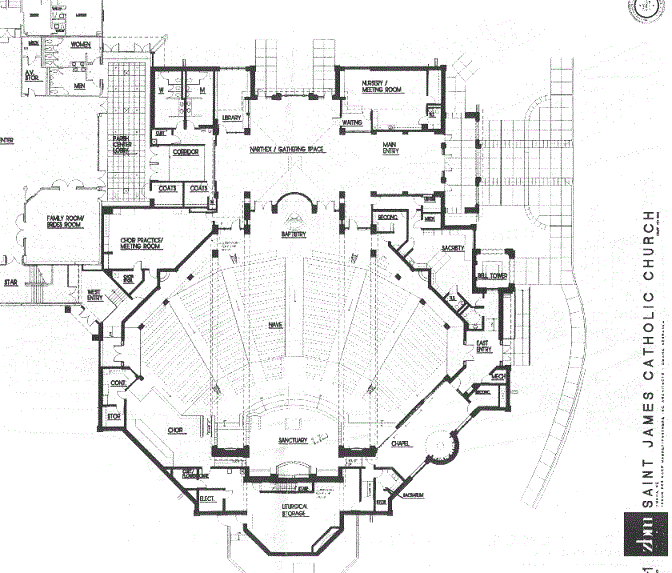
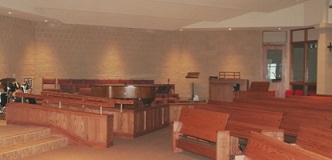
Also called the worship space, the nave is the large area of the church building where the body of the faithful assembles for Sunday and weekday Mass.  The nave stretches from the adoration chapel on one side to the choir area, and from the baptismal font near the main entrance to the sanctuary at the front of the church.
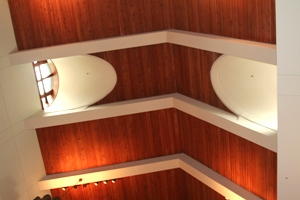
The most breathtaking feature of the nave is the high ceiling.   At the highest point it is about 52 feet from floor to ceiling.   The main upper ceiling is a combination of wood and drywall intended to create a warm environment with natural materials.   The wood is used in just the upper portion of the church to emphasize the uplifting feel of the space.

Also noteworthy in this area is the sloping floor, which includes a 14-inch rise from the steps of the sanctuary to the baptismal font.   The gentle slope is designed to improve the congregation's ability to see the sanctuary, but without creating problems for sitting, walking or kneeling.


The Baptistery Area

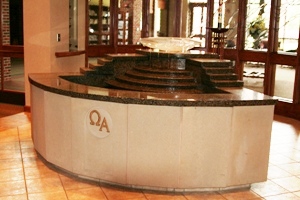
The highlights of the baptistery area, designed by ZBM, are the baptismal font, capped by a glass scallop seashell into which the water first flows, and a curved glass wall that partially encircles the font and baptistery area.    The remainder of the font is a combination of granite from Saudi Arabia and precast concrete.   The font is about 6 1/2-feet front to back by 8 1/2 feet.
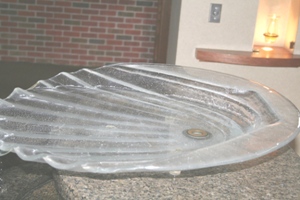
The baptismal and Holy Water fonts are part of the shell theme that ties the building to its patron saint.   From the upper glass shell, the water flows into a lower receptacle big enough to accommodate an adult being baptized at the eater vigil service.  


The shell, made of cast glass and about 34 inches in diameter,
also was made by Lambrecht Glass Studio, as were the shell-shaped
holy water fonts around the church.

Next to the baptismal font is the ambry, where the holy oils are kept.   Blessed by the archbishop each year at a special Mass, these oils are used in the celebration of a number of the Sacraments.

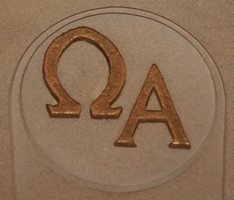
Inscribed on the panels on the perimeter of the font are the omega and alpha symbols.   That wording, omega first and then alpha (the end before the beginning), also ties in to the history of St. James.   At the cathedral in Spain that was built over the saint's tomb, the Omega-Alpha wording is seen in the entryway.   The church is the destination of pilgrims traveling great distances to reach St. James' tomb, and the wording signifies that while the pilgrims' journey is over, their new spiritual life with Christ has begun.
Behind the font is a 14-foot-wide curved wall.   The wall's wood frame holds sections of leaded glass that create a hint of flowing water.   Different textures of clear glass are used, with a background of mouth-blown antique glass from Lamberts in Germany.


The Pews

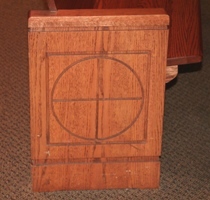
The solid oak pews were made by Ratigan-Schottler Manufacturing in Beatrice, Nebraska, the same company that manufactured the pews in the original St. James church.   The seats are without padding to ensure long-term durability but are contoured for comfort.   The circle and cross theme seen throughout the church's interior is visible in the ornate carving on the ends of the pews.   The kneelers are covered with heavy vinyl padding.
The 86 pews are arranged throughout the nave in a circular pattern to maintain the intimacy throughout the congregation that has been felt for many years in the parish.   The arrangement also helps to create a sense of closeness to the altar, with a relatively short distance between the farthest pew and the altar.   There is seating in the nave for about 720.


Lighting

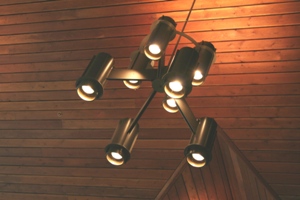
The key lighting feature is a computerized, programmable dimmer system that allows the creation of up to 15 different environments for worship.   These scenes, such as festive ones for Easter or Christmas or a somber one for Good Friday, can be implemented by pressing a single button.   The ZBM team of Dave Beringer and Doug Peters established an approach to the lighting and worked with electrical engineers from Farris Engineering to achieve it.   The hanging light fixtures incorporate both down lighting, which enables the congregation to see, and up lighting, which illuminates the ceiling space.


Sound System and Control Room

Liturgical celebrations call for the clear transmission of the sung and spoken responses of individuals and of the entire liturgical assembly.   That's exactly what the sound system at St. James is designed to do.  MuSonics Audio Design of Denver designed the system, and Electronic Sound, Inc. of Omaha installed it.
Two Duran "Intellivox" loudspeakers, located near the sanctuary, are architecturally integrated out of sight.   These "active" loudspeakers are internally computer-controlled to provide a very high degree of sound placement.   The sound is focused by temporarily connecting a computer to adjust the exact sound coverage for a particular listening space.   There are 17 speakers inside each enclosure that are individually controlled via a complex algorithm and digital signal processing.

Several additional speakers are located throughout the building and in various rooms.   An audio-visual cabled system is hooked up to help with overflow during church liturgies.

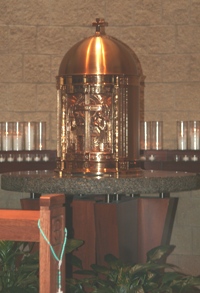
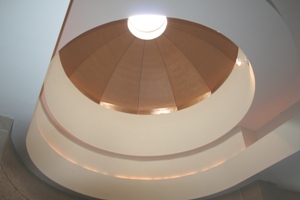
The 24-hour Adoration Chapel is located just off the east entry to the church.   A dome skylight in the chapel focuses natural light upon the tabernacle, where the Eucharist is reserved.   The dome above the tabernacle was initially painted blue to give the appearance of the heavens.  It was repainted with a brighter, golden color to reflect the light.


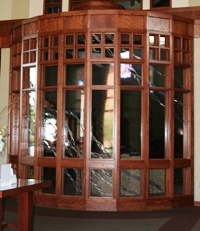
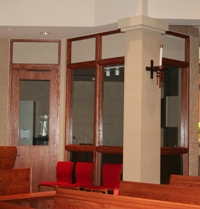
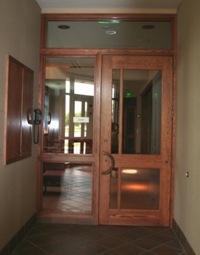
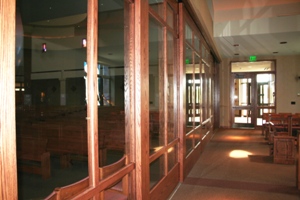
Sliding doors separate the chapel from the main church.  These doors, made of glass and wood, will be open during liturgies and at most other times.   This allows for both private and public adoration of the Eucharist.   However, the doors can be locked for restricted access into the Chapel through the east entry, allowing for private prayer in a secure environment.   Whether the doors are open or closed, the tabernacle remains visible from anywhere in the Church.
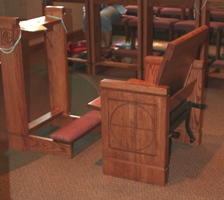
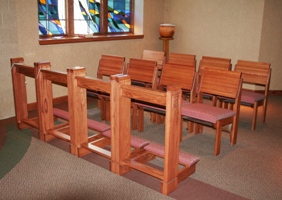
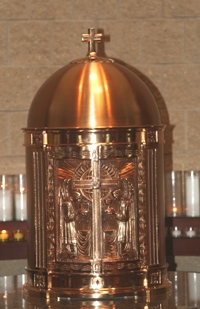
 

 Eighteen chairs and nine Prei Dieus, or prayer kneelers, are arranged around the tabernacle, making it the central focus of the Chapel.  They are all made of solid oak.   On the side of the Prei Dieus can be seen the same circle and cross pattern that appears on the pews and sanctuary furniture.   These can also be brought into the sanctuary for use at special liturgies.

The Reservation of the Eucharist (Tabernacle)

Christ present in the Eucharist is a treasure the Church has come to cherish and revere over the centuries.   Originally intended to temporarily house the Eucharist for the sick and homebound, the tabernacle has become a place where all come to adore Christ in the Eucharist.

A nursing home in Milwaukee was the former home of the
tabernacle now in the St. James Adoration Chapel

The tabernacle at St. James is a combination of brushed and highly polished bronze and is equipped with a single set of curved pocket doors.   The design on the tabernacle depicts two adoring angels offering bread and wine under the radiant halo of the cross, which echoes the theme of the two adoring angels in the flanking stained glass windows.

St. James  purchased the tabernacle from King Richard's Religious Artifacts in Chesterfield, MO.   King Richard's collects used church items and resells them to other churches.   The tabernacle formerly had been used in a nursing home chapel run by the Sisters of the Divine Savior in Milwaukee.

Votive Candles


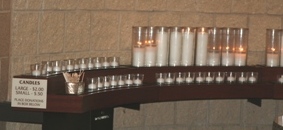
Votive candles were a new feature at St. James introduced in 2002.   Small and large candles surround the tabernacle in the Chapel where people with special intentions can light them.  The votive offerings can be placed in boxes near the candles.

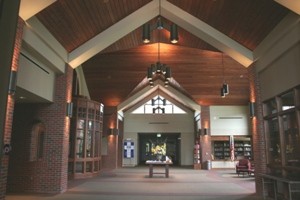
The narthex is a place of welcome - the gathering space at the main entranced to the church building, just outside the nave.   The area aids the transition from the outside environment of daily life to the celebration of the liturgy in the worship space.   It is intended to offer a comfortable and spacious environment for fellowship without upsetting the quiet, reverent atmosphere of the sanctuary and nave.   Besides the open area for gathering, the narthex area includes a family room, a library space, a coat room and restrooms.

Family Room

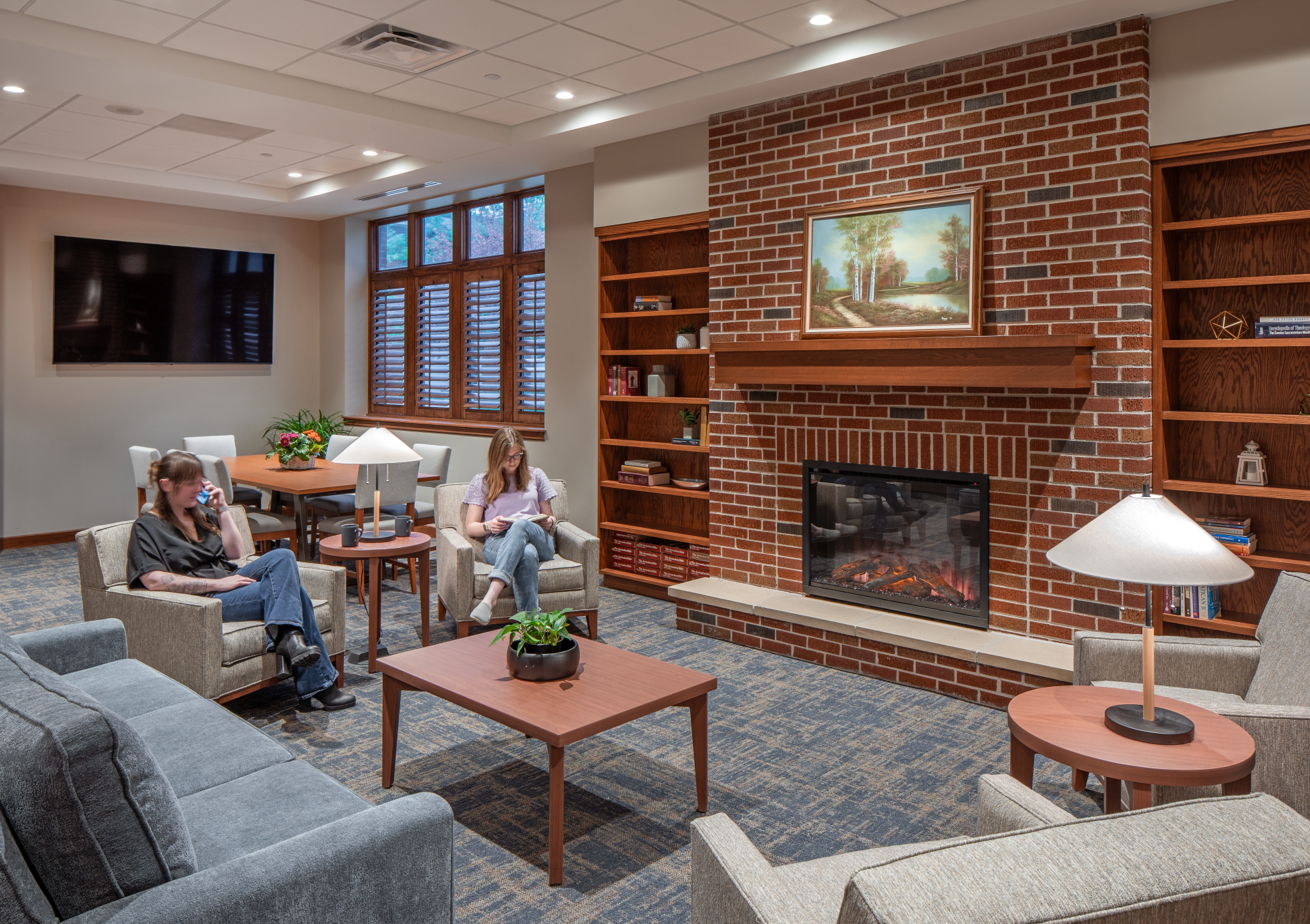
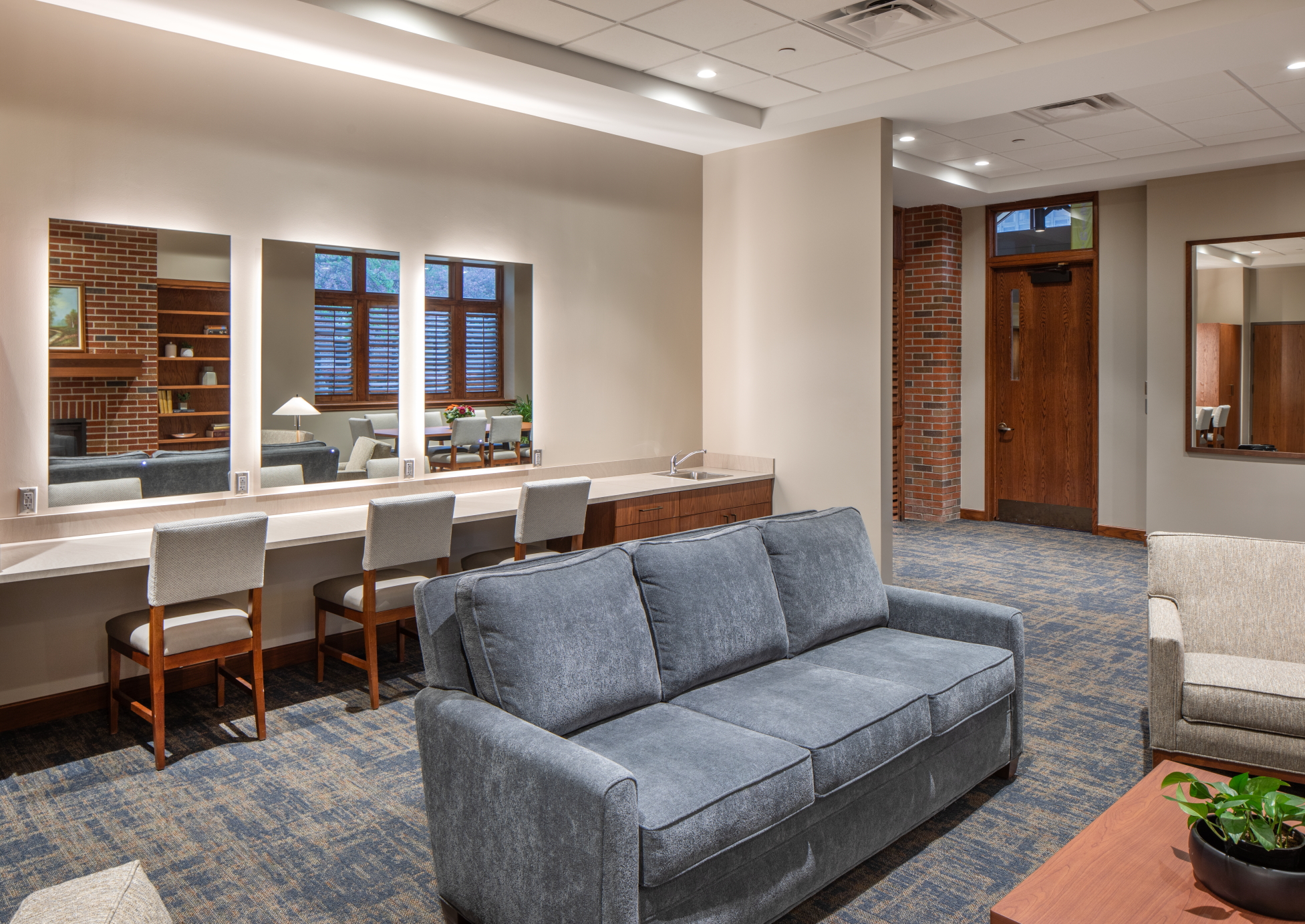
Once the parish nursery, the Family Room has been completely renovated into a welcoming and versatile gathering space. With new carpet, a fireplace, and a conference table with seating for eight, it’s perfect for ministry groups, leadership meetings, and Bible Studies. Comfortable couches, chairs, and a long table with mirrors also make this room an ideal bridal suite - providing brides and families a peaceful space to prepare for the Sacrament of Marriage.


Library

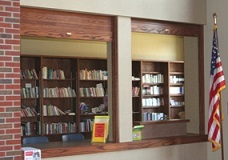
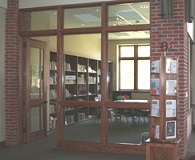
On the northwest side of the narthex is the library.   Its roll-up window facing the narthex allows people to readily purchase items such as HOPE certificates and other items, before and after church events.  The room contains bookshelves and glass cabinets for displaying items and books for borrowing by parishioners.   The library also serves as an extra meeting room.   Lost and found items are kept in the library.   Large containers are kept in the library for food donations to the St. James Parish St. Vincent de Paul chapter.

Memorial Gifts Book

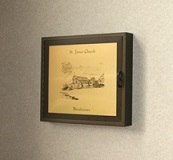
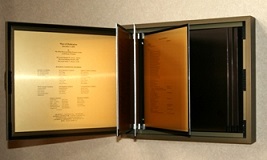
Located in the narthex just north of the nursery entrance, the memorial gifts book contains the names of St. James donors and/or those memorialized by their gifts.   The names are engraved on the book's metal pages.   The donations noted in the book include commemorative gifts or designated gifts for items such as the altar, windows, pews and baptismal font.   The book is kept in a metal box mounted on the wall with a picture of St. James Church on its front.

Cornerstone

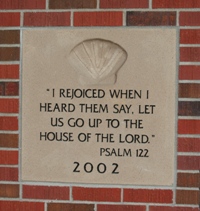
The 2-foot-by-2-foot precast concrete cornerstone is just to the left as you approach the main entrance to the church.   It also ties into the them of a pilgrimage.   Imprinted on it are a scallop seashell and words from Psalm 122. "I rejoiced when I heard them say, let us go up to the house of the Lord."
Mounted on the back of the cornerstone, out of sight, is a copper box serving as a time capsule.   The box has a variety of contents that give meaning both to the parish and to the year in which the church was built, including a 40th anniversary parish pictorial directory, new 2002 coins and a copy of the Catholic Voice.

ZBM designed the cornerstone, and it was cast by an Omaha-based company, Artisan Stone.

Restrooms and Coat Room

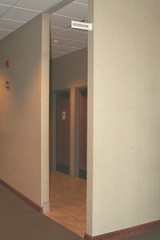
At the west end of the narthex, double doors lead to the Parish Center where many meetings and receptions are held.   To the right are restrooms with baby changing facilities and handicap access.   To the left is a coat room.  A wheelchair is kept in the coat room for emergency use.

Stations of the Cross

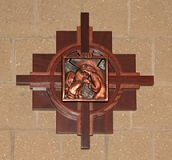
The Stations of the Cross in the new church are the same ones used in the former church.   The bronze squares continue to be the main focus, but new wooden backing in the shape of the circle and cross, has been added.
The Stations of the Cross originated early in the history of the Church.  It was the custom of the faithful to follow the way walked by Christ from Pilate's house in Jerusalem to Calvary....The Stations of the Cross offer a way for the faithful to enter more fully into the passion and death of the Lord and to serve as another manifestation of the pilgrim Church on its homeward journey.   Paragraph 132-33, Built of Living Stones


Choir Area

To the right of the sanctuary as you face the altar is the choir space, which includes seating for 40 and houses the musical instruments of the parish, including piano, keyboard and drums.   Next to this area is a sound and lighting control room.


Choir Practice Room

In this soundproof room, which is adjacent to the worship area on the west side, the musicians rehearse for the liturgy.   Its location allows for processional involvement and easy access to the choir location in the worship area.   The room seats 40.   Choir music and instruments are stored there as well.

Reconciliation Rooms

There are two rooms where the Sacrament of Reconciliation can be celebrated.  

The main one is in the back of the nave near the baptismal font.  

The other is in the chapel. 

In both rooms, confessors may receive the sacrament face to face or through a screen.


Sacristy

The sacristy, situated at the rear of the nave, holds the materials needed for the celebration of the liturgy.   It is also where clergy vest for liturgy.   A double-sided closet holding vestments acts as a divider for the room.   The left side, which has a private bathroom attached, is for the priests.   The right side is for deacons, Eucharistic ministers, lectors and servers.   There are two entrances into the sacristy: one from the narthex and the other from the east entry into the church.      


Sacrarium

The sacrarium is a special sink used for the reverent disposal of sacred substances.   After Mass, when the vessels are rinsed and cleansed, the water is poured into the sacrarium so that any remaining particles will not be poured into the sewer system but will go directly into the earth.   The sacrarium is between the chapel and the sanctuary for easy access following communion.

The Bell Tower

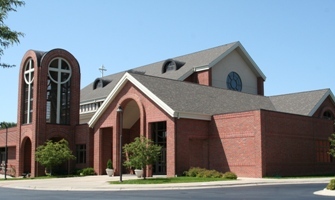
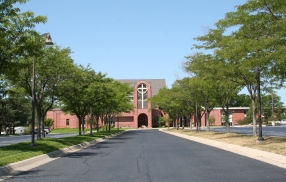
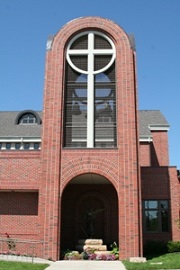
The position of the 42-foot bell tower makes it the focal point of the site from the 90th Street entrance.   Its positioning - next to the main entrance on the east side of the building - is a symbol of a call to worship.

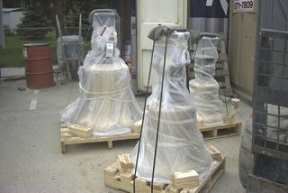
Its key feature is a bell-and-clapper system from the Verdin Company in Cincinnati, which was founded in 1842 and is one of the world's largest suppliers of bells.   The bells themselves were manufactured by the Royal Dutch Bell Foundry in the Netherlands, a company hundreds of years old.

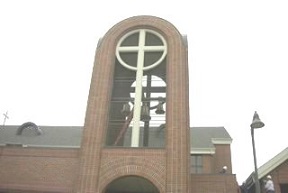
The system includes three bells of different tones and sizes in a tuned set.   The bells are stationary, but the clappers, operated through an electronic system, move to ring the bells.   (In other words, these are real bells with an authentic bell sound.)  The system can be set in a variety of ways, including random tolling for events such as weddings and funerals.

Each of the three bells is inscribed with one of these phrases.

Praise to God the Father
Praise to God the Son
Praise to God the Holy Spirit

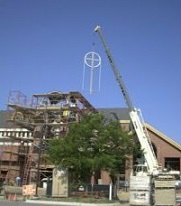
These photographs are from Summer and Fall 2002 while the church was under construction.

Four crosses, each about 24 feet high, adorn the bell tower.  Another, even more visible, cross,
about 8 feet high, is mounted on the south end of the main roof, the highest point of the church.   
That cross is about 70 feet above Tomahawk Boulevard to the south.

Statue of St. James

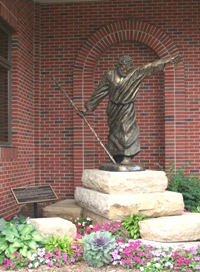
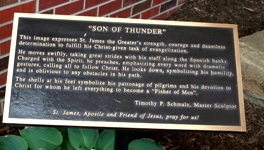
The statue of St. James is located at the base of the bell tower.  The plaque reads:

This image represents St. James the Greater's strength, courage and determination to fulfill his Christ-given task of evangelization.

He moves swiftly, taking great strides with his staff along the Spanish banks.  Charged with the Spirit, he preaches, emphasizing every word with dramatic gestures, calling all to follow Christ.   He looks down, symbolizing his humility and is oblivious to any obstacles in his path.

The shells at his feet symbolize his patronage of pilgrims and his devotion to Christ for whom he left everything to become a "Fisher of Men."  - Timothy P. Schmalz, Master Sculptor

St. James Apostle and Friend of Jesus, pray for us!

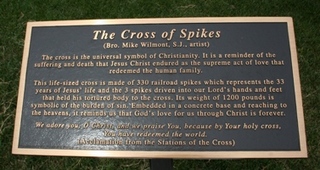
The Cross of Spikes

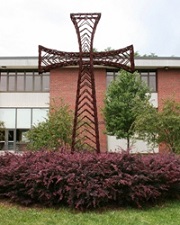
In the midst of the grassy courtyard between the church and the school is the Cross of Spikes.   The plaque reads:

"The Cross of Spikes (Brother Mike Wilmont, S.J. artist)

The cross is the universal symbol of Christianity.   It is a reminder of the suffering and death that Jesus Christ endured as the supreme act of love that redeemed the human family.

This life-sized cross is made of 330 railroad spikes which represents the 33 years of Jesus' life and the three spikes drive into our Lord's hands and feet that held his tortured body to the cross.   Its weight of 1200 pounds is symbolic of the burden of sin.   Embedded in a concrete base and reaching to the heavens, it reminds us that God's love for us through Christ is forever.

We adore you, O Christ, and we praise You, because by Your holy cross, you have redeemed the world.
(Acclamation from the Stations of the Cross)

The Architects and Artisans

Dave Beringer: A St. James parishioner, Davis is president of Zenon Beringer Mabrey, the Omaha architectural firm that designed the new St. James church building.  Dave and ZBM have worked on other ST. James projects, including the parish center, the overall master plan and the ongoing project to renovate and add on to St. James/Seton School.   Dave and his wife Carol, have been parishioners since 1969, and their three now-grown children, Rob, Susanne and Jeff, graduated from the parish school.

ZBM has worked on a number of other churches, including St. Elizabeth Ann, St. Gerald in Ralston, St. Patrick in Gretna, St. Patrick in Fremont and the chapel at Elkhorn's Mount Michael Abbey.  Other projects include St. John Vianney in Omaha and St. Clare in O'Fallon, Illinois.

Besides Dave, other key ZBM architects on the St. James project included Doug Peters, who with Dave was a co-designer;  Cheryl Kiel, who prepared the technical drawings; John Brennan, who monitored the construction process; Steven Ginn, who designed the liturgical furnishings; and Connie Emanuel, who was the interior designer.  Farris Engineering was ZBM's mechanical and electrical engineering consultant.

Mark Lambrecht: With his wife, Kristi, Mark owns and operates Lambrecht Glass Studio in Omaha's Old Market area, where the studio has been based since 1995.  Lambrecht and his staff, who designed the stained glass and other glass elements in the new church, have a 224-year tradition in the glass business and have worked on a number of churches, both in the Omaha area and nationally.   Kristi is the design and layout specialist for the Lambrecht team, with Mark handling the production and business ends of the operation.

Anton Fuetsch: An Austrian native who now lives and works in Berkeley, California.   Anton is a master woodcarver, creating pieces that range from ornate mantelpieces and wall carvings to sculptures and large-scale work for churches.   He created the Madonna and child state and the St. Joseph state for St. James.

Paul Kemp:  Paul was responsible for re-polishing and refurbishing the corpus on the cross hung in St. James Church.  At the time of the dedication, he had worked for Wood Specialties of Omaha for 16 years.   Paul and his wife, Marla, for twenty years.   They have two daughters, Brianne and Laura.   Paul is active as a Eucharistic Minister.

The Constructors and Craftsmen

Lund-Ross Constructors:  An Omaha company formed in 1987, Lund-Ross was the general contractor for the church project.   Dick Carpenter was the project superintendent and his team included Tim Donovan, the project manager, and Brent Williams, the field manager.

Fucinaro Excavating Company:  The earthwork for the new construction was done by this Omaha company.  Dave Fucinaro, a partner in the multi-generational business is a member of St. Elizabeth Ann Parish.   He and his wife, Diane, have three children, all of whom attend St. James/Seton School.

URS Corporation:  Ken Nass, a St. James parishioner, did the soil testing for the project as part of his work for this company.

Baldwin Carpet:  Jim Baldwin, a St. Elizabeth Ann parishioner, owns this company, which supplied and installed all the carpeting for the new church.

Fortina Tile Company:  This company, led by Brian Fortina, did the ceramic tile work in the new church building, including the bathrooms, sanctuary, baptismal font and entryway.   He and his wife, Laura, are parishioners at St. James, and their two children attended St. James/Seton School.

National Electric Company:  Rick Milota of National Electric was the electrical contractor.  His father, the late Richard Milota, was the former president of the company and a St. James parishioner.  Sharron Milota, Rick's mother, is still a member and has been since 1968.  Rick is a 1980 graduate of St. James School.

Double D Excavating:  The original rectory building at 9130 Tomahawk Boulevard was demolished and removed by Doube D.   It is owned by David Doll, whose wife, Sue Doll, works in the office at St. James/Seton School.

L.A. Sprinkler:  St. James parishioner Pete Wolters owns this company, which installed a lawn-sprinkler system on the church grounds.   He and his wife, Darcy, have two children, Claire and Joseph, who attended ST. James/Seton School.   Pete served on the Parish Council and had also been president of the Council.

The Building Committee

Executive committee: Fr. Michael Grewe, Fr. Raphael Walsh, Fr. James Brown, Debbie Armentrout, Joe Laferla.

Other committee and subcommittee members:  Dick Batenhorst, Katie Biggs*, Dick Birkel, Maryann Boscardin, Helen Bosiljevac, John Bradley, Steve Byers, Laura Clark, Jerry Coon, Terry Crum*, Gregg and Carol Drvol, Mary Ann Dunning, Jim and Linda Ely, Lisa Ferrer, Diane Fucinaro, Greg Goergen, Nancy Gomez, Randy Grosse*, Gary Heller, Rich Hopkins, Georgia Johnson, Bob Karr, Paul Lamoureux, Gina Langin, Bob McDonald, Jim McKinley, Scott Michaelis, Steve Morford*, Lisa Nelson, Lowell Newhaus, Mike Patterson, Joseph Pletka, Harold Ramsour*, Don Reiner, Tim Ryan, Nancy Schulte, Teri Teutsch, Rich and Louise Vacek, Dave Volenec, Dan Walsh, Chris Young, Ed Weidner*, Paul Wenninghoff, Pete Wolters.
*committee chairs

About This Booklet
Editor: Randy Grosse
Designer: Becky Gima
Writers: Bob McDonald, Lisa Schulte
Coordinator: Georgia Johnson
Photographer: Tom Herbert
Construction Photos: Chris Young
Printer: Rainbow Press (Pete and Joyce Grotzinger, owners)

Ave Maria Mutual Funds Wide Sponsorship Banner